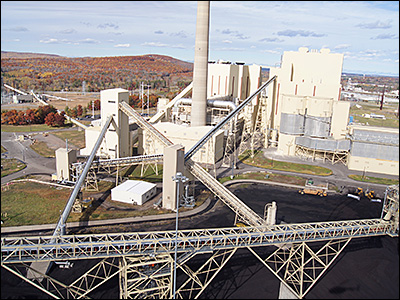
April 12, 2013 - By a unanimous vote, the Public Service Commission of Wisconsin granted approval to the WPS application to install the new, multi-pollutant control system (ReACT) at the Weston Generating Unit 3.

WPS will design, construct, install and operate an emission control system on Unit 3 at the Weston Power Plant site.

The system, known as ReACT (Regenerative Activated Coke Technology) will significantly reduce sulfur dioxide (SO2) nitrogen oxides (NOx), mercury (Hg) and other emissions from the exhaust flow.

The new system is in addition to the existing exhaust controls of the Weston 3 fabric filter (bag house installed in 2000), the low NOx burners and separated over-fire air system (installed in 2009) and the mercury control system (installed 2009).

The 321-megawatt Unit 3 electric generator began operation in 1981 and is fueled by Powder River Basin (low sulfur) coal from Wyoming.

The new ReACT system will cost $250 million and will be operational in 2016. This addition will put the unit in compliance with federal and state air emission regulations.

Historical results of using this technology at other similar units like Weston 3, showed greater than 90% of SO2, 90% of mercury, and 20% of NOx being removed from the exhaust stream before going out the stack and into the air.

The system uses activated coke pellets on a slow moving conveyor belt and as the boiler's exhaust passes over the conveyor system, the S02, NOx and mercury attaches and is absorbed into the pellets. The pellets are then collected, heated and the pollutants are then broken down and isolated in a by-product recovery system, where they are treated and kept for potential beneficial reuse.

Timeline Completion Date
Regulatory and Permitting Approvals May 2013
Contracts Awarded Jun 2013
Construction 2014
Operational 2016

Note: The project will take 30-36 months to complete and bring about 200 temporary construction jobs to the power plant.

History

The Weston Generating Station site is located on 345 acres in the Village of Kronenwetter and Rothschild in Marathon County in central Wisconsin, about 7 miles south of the City of Wausau.

The site has four coal-fueled electric generating units, two combustion turbines, a substation and fuel supply systems.

ReACT Technology

Regenerative activated coke technology (ReACT) is a dry scrubbing system and involves three stages.

  1. Absorption Stage - The exhaust flue gas comes in contact with a slow moving bed of activated coke pellets on a conveyor system. SO2, NOx and mercury are absorbed when coming in contact with the pellets.
  2. Regeneration Stage - The activated coke pellets containing the SO2, NOx and mercury are transferred to a thermal regenerator, where reactions take place and the pollutants are released into a sulfur gas stream.

    This is done in the regenerator vessel by pre-heating, heating and then cooling the pellets. The pellets are returned to the absorption stage. The absorbed mercury is then collected in the bottom of the vessel.
  3. By-Product Recovery Stage - The sulfur-rich gas containing the SO2 and NOx flows to an adjacent acid recovery plant where a good quality sulfuric acid is produced, stored and prepared for re-sale.

ReACT History

The concept and technology originated in Germany in the 1950's. Additional development took place in the 1970's. The process was refined and used in Japanese mining in the 1980's and finally developed into a full commercialization effort by the Electric Power Development Company as an advanced multi-pollutant control technology that was an alternative to a wet flue-gas desulfurization process. The ReACT process has been used successfully in Japan and in the U.S. at the North Valmy Station in Nevada, operated by Sierra Pacific Power.

WPS Certificate of Authority

The application for this project can be found on the Public Service Commission of Wisconsin website. The official docket number is 6690-CE-193.

Contact Information